Sri Lanka has been known by many names over the centuries. Ceylon was the name given by the British and before that it was famously known as Serendib. Ceylon can be traced back to root Sanskrit in names such as Sinhala, Selian, Seylan whereas Serendib comes from Arabic, which became Serendip in Persian and led to one Horace Walpole coining the word Serendipity in 1754 - meaning “ happy accident “. I can easily imagine over the centuries the many explorers and travelers indeed feeling like that had encountered a happy accident on visiting this most beautiful country. The island was renamed Sri Lanka in 1972, meaning “ resplendent land “ and it is a most accurate description.


We happily arrived on purpose, on Boxing
Day, which infamously is the day 7 years ago where much of the coastline
was devastated by a massive 9.3 magnitude earthquake generated
tsunami that hit many other countries shores and so many lives were
lost.
Sri Lanka's main international airport
is near Negombo and about 30 km's from Colombo. It had been our
intention to get to Colombo by possibly train or taxi or tuk-tuk,
then hopefully catch the train to Kandy. Due to our plane being a
little late for this option plan b came into effect. Plan b hadn't
really even been considered so it was a quick check of Official
Airport Taxi prices followed by observation of what was happening
transport wise outside the terminal. Local buses were deemed too old
and too slow ( some understatement ), small crammed mini vans were
not really that much cheaper than a taxi, so taxi it was. After some
friendly hard sell from various touts we decided on one jovial chap
who bought his price down a bit from about $70 to $55. We initially
thought this was pretty expensive and were sceptical of the “ but
Sir, Madam it takes many hours to get there and the price of petrol
here is so high “ lines that we were given, however they turned out
pretty true. It is only about 80kms from Negombo to Kandy and we soon
found out that the many hours to get there was indeed accurate. The roads
are narrow and not maintained, full of pot-holes either lumpily repaired or not and once you get on the main
roads very congested which prohibits any idea of fast travel.
 We left the airport at about 7.30am
and we were immediately mesmerised by the riot of colour that is Sri
Lanka, from the lush verdant multi shades of green of the landscape
to the bright colours of the shops stocked with all manner of goods, peoples dress, the brilliant
decorated trucks and tuk-tuks cluttering the roads, indeed everything
is a wonderful colour contrast.
We left the airport at about 7.30am
and we were immediately mesmerised by the riot of colour that is Sri
Lanka, from the lush verdant multi shades of green of the landscape
to the bright colours of the shops stocked with all manner of goods, peoples dress, the brilliant
decorated trucks and tuk-tuks cluttering the roads, indeed everything
is a wonderful colour contrast.
Our driver who's name I forget ( his
card is in my wallet so somebody somewhere might know it ) was a very
friendly and humble man, his english very good and he was full of
information. We stopped after about 45 minutes for refreshment at a
roadside restaurant. After egg rolls and delicious tea we were ready
for the big drive. You soon start steadily going uphill and the
driving is something to behold. First thing you notice is the
tooting. People toot the vehicle in front just to let them know they
are there, and they toot gain when passing. Passing is a story of
it's own. Due to the large volume of traffic much passing and tooting
is required in order to get anywhere. It was not uncommon to have 2 or 3
vehicles all doing different speeds, simultaneously passing and
tooting at a truck with a blind bend looming. No problem as any
oncoming traffic is completely used to this sort of thing and either
moves over or stops to allow the passers to accomplish their task, or,
some or all of the passers fall back into line again and wait for the
next opportunity, most often at the next blind bend. Initially this
is all quite alarming as nobody is doing much more than about 50kph so you
will have a truck doing 20kph, one passer doing 30, the next 40 and
the next 50...but you soon get used to it and there are surprisingly
very few accidents and there is not one bit of road rage to be seen.
 Sri Lankans seem imbued with a kind of
peaceful happiness and don't appear to get upset very often, if at
all. They need quality this in abundance for the roads and driving I am convinced.
We soon found that Sri Lankans may just be the some of the most
contented people on the planet. Wherever you go people are friendly,
if eye contact is made a smile and a hello seems almost compulsory.
This in direct contrast to the level of poverty. I use the word
poverty with caution in the sense of monetary wealth only. There are
undoubtedly wealthy people but in general most are not. They most
certainly aren't poor in so many other areas of their lives, they
accept their place in their society and get on with life generally
with a smile and kind words.
Sri Lankans seem imbued with a kind of
peaceful happiness and don't appear to get upset very often, if at
all. They need quality this in abundance for the roads and driving I am convinced.
We soon found that Sri Lankans may just be the some of the most
contented people on the planet. Wherever you go people are friendly,
if eye contact is made a smile and a hello seems almost compulsory.
This in direct contrast to the level of poverty. I use the word
poverty with caution in the sense of monetary wealth only. There are
undoubtedly wealthy people but in general most are not. They most
certainly aren't poor in so many other areas of their lives, they
accept their place in their society and get on with life generally
with a smile and kind words.
 At 9.28am we stopped on the side of the
road to observe 2 minutes silence in remembrance of the tsunami which
has affected and still does so many peoples lives. Over 36,000 people
lost their lives to the tsunami, 90,000 homes and buildings were destroyed
and an estimated 1 million people displaced by this tragic event.
Evidence of the tsunami can still be seen on the coast, although much
rebuilding has been done, and this undoubtedly has ongoing
implications in Sri Lanka's fragile economy.
At 9.28am we stopped on the side of the
road to observe 2 minutes silence in remembrance of the tsunami which
has affected and still does so many peoples lives. Over 36,000 people
lost their lives to the tsunami, 90,000 homes and buildings were destroyed
and an estimated 1 million people displaced by this tragic event.
Evidence of the tsunami can still be seen on the coast, although much
rebuilding has been done, and this undoubtedly has ongoing
implications in Sri Lanka's fragile economy.
Nearing Kandy we stopped at a tea
factory for a tour and obligatory cuppa. We left bearing bags of tea
and smiles.
We got to our guest house, the Forest
Glen, after some difficulty finding it, but our driver once again was
invaluable through being able to phone,get directions, drive and toot
simultaneously. It was about 1pm and we were pretty much exhausted.
After a wee rest and a nice pot of tea we felt restored
enough to venture off in to Kandy for a bit of a look around.
We had visited Sri Lanka in 1980 and
felt pretty sure that we had been to Kandy, however we soon figured
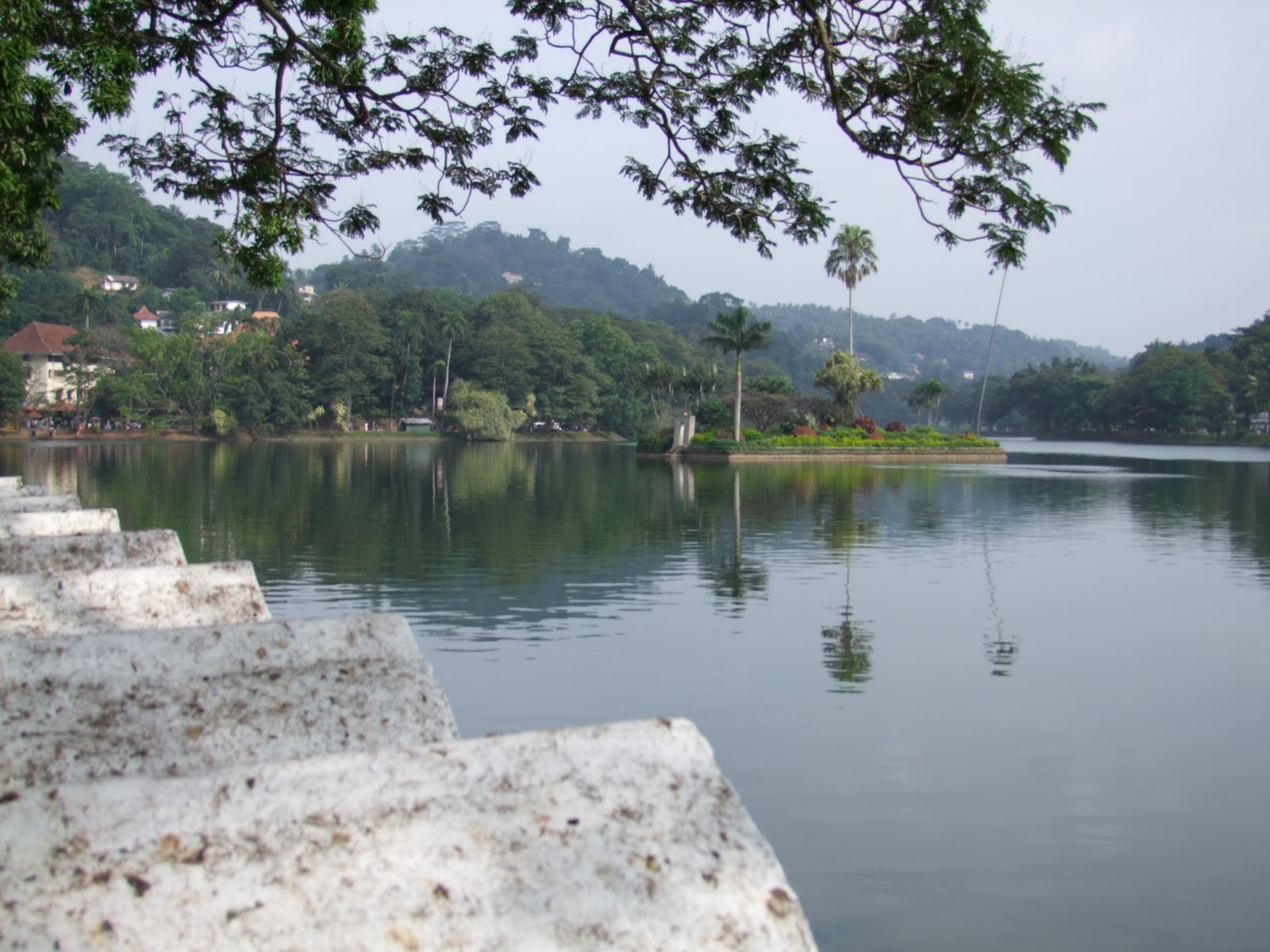
that we mustn't have as who could forget this very pretty hill town
and it's lovely central lake. Being somewhat hungry we found a good
restaurant and tucked into some deliciously spicy samosas and
pastries washed down with an invigorating and delicious local ginger beer.
Back at our guest house, Indra our
wonderful host soon had dinner ready and what a feast. Some of the
best Sri Lankan curries were enjoyed at Forest Glen thanks to Indra's
culinary ability, every dish being spicy yet subtle and so many
different tastes with each curry. The hard beds at the guest house
are worth suffering for the magnificent food. We were usually pretty
exhausted after each days exploration so a good sleep was almost
assured anyway.
Breakfast the next morning was
fantastic with local fresh fruits, eggs any style you wanted ( I opted for a fine chilly omelette ) and endless tea if you
wanted it. Friends Alan and Joy, then Colin and Cookie, who had stayed here at different times had recommended this place and we would as well with no hesitation. Just don't forget to shut your windows during the day
as the monkeys will almost invariably come in for an inspection if
you forget. Mayhem no doubt would ensue.
That day we explored Kandy town, found
an internet cafe ( at a ridiculous 3 cents for 1/2 hour ) to check on
mail and visited the Temple of the Tooth. The Tooth Temple
majestically stands beside the lake and is one of the most revered
and visited temples in Sri Lanka. Beautiful buildings and pretty
grounds can be explored and enjoyed for hours.
Of course you can go more up market
where a pot of tea in a hotel is more like $2.00, an espresso about
$3.00 and lunch or dinner around $10.00. The most we ever paid and
possibly one of the best seafood meals we've ever eaten, which included
2 bottles of beer, juice and water was about $35.00 all up for the
two of us. This was at a delightful small cafe/ restaurant right on
the beach with views to die for – it doesn't get much better.
 Next day Indra had organised a driver
for us ( all day for $40 ) to take us first to the elephant orphanage
at Pinnawala and then onto the botanical gardens at Peridiniya and
finishing with a spectacular display of traditional Sri Lankan
dance. We can highly recommend all of these visits if you are ever in
Kandy. A possibly interesting and little known fact that is, that
about 80% of elephant poo is fibre – they are very poor digesters
apparently. As a result of this, and an excellent local money earner
both for the locals and the benefit of elephant health and upkeep,
their product is recycled into paper goods such as calendars, books,
envelopes etc...it can also be compacted into moulds of you guessed
it elephant statues. Watching the elephants go down to the river for
their daily wash and swim was magic. Many elephants were either
injured ( bullet wounds, land mines etc.. ) or orphaned during the
time of the wars with the Tamil Tigers. The orphanage does such good
work looking after and rehabilitating elephants from small babies and
juveniles to large adults.
Next day Indra had organised a driver
for us ( all day for $40 ) to take us first to the elephant orphanage
at Pinnawala and then onto the botanical gardens at Peridiniya and
finishing with a spectacular display of traditional Sri Lankan
dance. We can highly recommend all of these visits if you are ever in
Kandy. A possibly interesting and little known fact that is, that
about 80% of elephant poo is fibre – they are very poor digesters
apparently. As a result of this, and an excellent local money earner
both for the locals and the benefit of elephant health and upkeep,
their product is recycled into paper goods such as calendars, books,
envelopes etc...it can also be compacted into moulds of you guessed
it elephant statues. Watching the elephants go down to the river for
their daily wash and swim was magic. Many elephants were either
injured ( bullet wounds, land mines etc.. ) or orphaned during the
time of the wars with the Tamil Tigers. The orphanage does such good
work looking after and rehabilitating elephants from small babies and
juveniles to large adults.
The botanical gardens were beautifully
maintained with plants, palms and trees from around the world,
including giant Queensland Agathis Robusta ( looks exactly like NZ
Kauri – Agathis Australis ) and Seychelles Coco-de-mer. A seemingly
popular pastime, and there were 100's partaking, was snuggling. Wherever we ventured young couples were entwined in each others arms
in the shade of many trees and palms. All very decent and quite
romantic.
The dancing that evening was
spectacularly colourful and very energetic with some exceptional
bouts of acrobatics and super speed whirling.
Day 4 in which Brian has an intriguing
no wallet experience and discovers the healing abilities of the
excellent local stout.

Suffice to say my normal easy descriptive ability abandoned me when I discovered that familiar bump in my back pocket was absent...I was gob smacked...literally and I think from memory about the worst that escaped my mouth was something like Gosh my wallet has gone, I can't believe it but it has definitely gone...what will I do. Blimey.
Lynne says she remembers me at least mouthing a certain undesirable word, but I'm unconvinced – she has an unreliable memory and is never one to let the truth get in the way of a good story.
Shock I suppose does strange things to
people. I still can't quite believe it happened...Ok it was in my
back pocket, not a brilliant place I now realise to keep it, however
the pocket was rather deep and has a good stick Velcro fastener ( I'm
not going to buy Velcro shares now that's for sure ). It was a busy
platform change of trains and although I thought I was pretty aware
of anyone around me I must give credit to whoever was able to
extricate the wallet from my back pocket. Within seconds of boarding
the new train and I think this is when it happened I noticed it was
gone. Too late already to do anything as the train had started
moving. This sort of thing can happen anywhere in the world and could
result in bodily damage or loss of life, before wallet removal, in many
countries so I suppose I am lucky. I can't imagine violence being
used in Sri Lanka for this sort of thing – your'e more likely to be
accosted by someone politely asking “ Sir may I have your wallet I
could really do with the money “, “ No please go away “, “ Ok, sir,
sorry to disturb you, have a nice day “.
I would prefer to still have it but
$150 gone won't kill me and I think somebody somewhere is having a
real good time spending it. If you had a good job in Sri Lanka that could be more than half a months salary and for the many not so fortunate, months and months.
The loss of the wallet itself was the hardest, as it had been a present from a friend, then the hassle of
having to report and cancel lost credit and ATM cards, health cards
and drivers licences. All of these can be re-issued with a bit of
time...I do miss that wallet though, it was a beauty. That $150.00
could have been useful too I suppose if I'm honest and who knows the
US$100 bill I had secreted away in that wallet, for an emergency, may
never have been discovered.

While watching the one day cricket we
met and chatted with a nice young couple and it was at this time that
I thought I might avail myself of the stout. Having so far drunk only
the local Lion lager, the stout seemed appealing. After a few tasty
mouthfuls I thought this stuff is starting to have an interesting
affect and thereby discovering printed on the label 8.8%. Serious
beer then. After 2 big bottles I was feeling very mellow and it had
certainly taken the wallet episode off my mind. It is no wonder my shots at snooker later that night were haphazard at best.
During the 2 day stay in Nuwara we
visited another tea plantation and factory, walked everywhere and
found the Franciscan Nunnery where they sell ( and we bought ) the
most divine pickles and sauces.
Day 6 involved a long shared taxi ride
down from the hills to the south coast. Wherever you drive in Sri
Lanka the scenery is just magnificent, from the variety of lush
greenery to majestic waterfalls, interesting little villages and then
having to quickly stop as a large monitor lizard decides to cross the
road in front of you. This happened quite a few times. Also observed
on the road were many high speed squirrels and one mongoose and a
lady walking 2 porcupines on leashes. Our driver saw a snake but we
missed that fellow.
After a 6 hour drive we finally arrived
at out destination Tangalla Bay where we were to spend the next 6
days and what a heavenly place it is. Beautiful coconut palm fringed
beaches fronting crystal clear and vivid blue/ aquamarine seas. The
water temperature was just perfect and much time was spent swimming
and sunbathing, snorkeling, lazing about or relaxing at a beach cafe/
restaurant and for one of us most early mornings and evenings were spent
on the rocks fishing. I think I must have quickly become the talk of
the area - ah that crazy kiwi out there every day with fishing rod and
assortment of colourful lures. I met so many interested and very
friendly locals, either on my way out to one of the rocky points
at each end of the beach, or out on the rocks fishing. My bag of
tricks was always keenly inspected and talked about and advice given.
I had so many asking me to give them ( as presents ) my lures,
fishing rod and reel. By the end of my stay most of my lures were
given away, a few were lost to being busted off on the rocks when a
fish was hooked and lost, my rod was swapped for an assortment of
beautiful shells, one fish was successfully landed and I had the most
enjoyable fishing I've had for years. One morning I will especially
treasure is where one of the local fishermen took me out on his
traditional outrigger boat, a fantastic experience.

 Our hotel the Tangalla Bay Hotel is a
fantastic and to my mind enduring piece of 1970's architecture.
Our hotel the Tangalla Bay Hotel is a
fantastic and to my mind enduring piece of 1970's architecture.
The brainchild of local Tangalla
identity Dr. Wickramasooriya who commissioned Sri Lankan modernist
architect Valentine Gunesekara for the design. Gunasekara is
apparently an admirer of Le Corbusier’s work and created a hotel
incorporating many of his ideas: a central corridor from the entrance
to bedrooms that soars/ floats over a ground floor dining room while
stairs lead down concrete flues to lower levels. The building’s
layout resembles a lobster spread-eagled on the rocks although others
liken it to a ship. It is certainly unique.
Besides just taking it easy we did a
couple of day trips. One started as a trip to nearby Matara to
organise future train tickets, however upon arrival at the station we
found that there were no trains due to the main line being relaid.
Our tuk-tuk driver suggested a ride out to the local and famous
Weherehena Buddhist Temple which was a fascinating place. An
artificial cave, decorated with many hundreds of colourful somewhat
gaudy paintings, it was like being inside a comic book life story of
the Buddha. Then on to Dondra Head, the southernmost point in Sri
Lanka and the site of a magnificent old and still operational
lighthouse. I did the climb to the top and was rewarded by
spectacular views up and down the coast.
Our tuk-tuk driver was a lovely bloke
and told us of the loss of his daughter during the tsunami. His wife
was 8 months pregnant and amazingly both parents survived. They now
have a lovely 7 year old son. A tragic story, just one of the many
thousands of similar stories of the loss of family and loved ones,
the legacy of the tsunami lives on and has had such a huge effect
particularly on those living on and near the coast.
 With time still
to spare we decided to go further along the coast to Galle.
With time still
to spare we decided to go further along the coast to Galle.
 With time still
to spare we decided to go further along the coast to Galle.
With time still
to spare we decided to go further along the coast to Galle.
Much of Galle's interest is centred
around the huge old Dutch fort built on the southern promontory.
A fascinating maze of streets with splendid old buildings, buzzing with activity. We only had a few hours but you could easily stay here for days and explore the fort and its many shops, cafes, restaurants and beautifully restored houses and buildings or observe the goings on in many of the still operational courthouses, administrative buildings, the waterfront etc...The wall, beside the sea, late in the afternoon is very busy and a popular place to unwind at the end of the day and wait for the sunset.
A fascinating maze of streets with splendid old buildings, buzzing with activity. We only had a few hours but you could easily stay here for days and explore the fort and its many shops, cafes, restaurants and beautifully restored houses and buildings or observe the goings on in many of the still operational courthouses, administrative buildings, the waterfront etc...The wall, beside the sea, late in the afternoon is very busy and a popular place to unwind at the end of the day and wait for the sunset.
On another day trip ( and the only
rainy day ) we caught a tuk-tuk to beautiful Dickwella beach, (
interesting name, nearly as interesting as Wackwella near Galle –
what goes on there I wonder? ) and explored the nearby Ho-o-maniya
blowhole, which unfortunately only really goes off during the months
of June to August where the large southerly swells force water up a 23
metre high natural chimney then another 18 plus metres into the air –
must be something to see. That day we also visited the impressive Mulkirigala rock temples. A decent climb of over 500 steps brings you to a series of cave temples with reclining buddhas and adorned with some amazingly colourful wall and ceiling paintings. On return to the hotel I discovered that I had left my glasses at the temple site. A hurried tuk-tuk ride there and very luckily, thankfully not too many steps up, one of the monks had found them and put them aside on one of the collection plates - they got an extra late donation that day.
 We cant speak highly enough of this
southern part of the coast, it is far enough away from the more
popular and busy beaches like Hikkaduwa and Unawatuna to allow
complete peace if you want it, yet close to so many interesting
places to explore if you feel the need. I could have stayed here for
months.
We cant speak highly enough of this
southern part of the coast, it is far enough away from the more
popular and busy beaches like Hikkaduwa and Unawatuna to allow
complete peace if you want it, yet close to so many interesting
places to explore if you feel the need. I could have stayed here for
months.
Sadly our holiday was near an end. A
local bus to Matara from Tangalla takes an hour and costs $1 for two
people. The smaller a/c bus from Matara to Colombo takes about 4
hours and cost $6 for two plus another $3 as our bags took up one
seat. Seemingly no luggage compartment, we didn't even care to ask.
Arriving in bustling Colombo we stayed just long enough to have a cup of tea and then catch the
bus to Negombo where we were to stay our last night, before flying
out the next day. Negombo is a busy beachside city handily located
near the airport. It has an interesting array of shops, restaurants,
bars and tour companies on the street immediately parallel to the
beach where many of the hotels are.
 Our hotel, the Golden Star turned out
to be completely and utterly misnamed. It was neither golden or star
like in any sense apparent to us. It was the worst hotel of our
vacation, had no in room tea and coffee making facilities ( which is
the norm ), a dirty bathroom and shower, no TV, uncomfortable beds,
mosquitos and no mosquito net. No power adaptor could be supplied and the next morning no hot water.
Our hotel, the Golden Star turned out
to be completely and utterly misnamed. It was neither golden or star
like in any sense apparent to us. It was the worst hotel of our
vacation, had no in room tea and coffee making facilities ( which is
the norm ), a dirty bathroom and shower, no TV, uncomfortable beds,
mosquitos and no mosquito net. No power adaptor could be supplied and the next morning no hot water.
They tried to add a 10% service charge
on top of our bill and I had great delight in carefully explaining to
them, when they offered no service whatsoever, why we wouldn't be
paying this extra charge. As they couldn't give any examples of the
service we were supposed to pay for, they quietly relented and
dropped the charge.
The beach itself warrants less recommendation than the hotel. It looked pretty enough during sunset the night we arrived, but an early morning walk presented us with rubbish strewn everywhere, the sea was a dirty brown colour and there was evidence of human waste along the beach. Yuk!! We observed one old fellow having his morning constitution right next to one of the traditional boats on the beach - it may have been his boat, who cares, if you haven't got or can't find a proper toilet then at the very least dig a deep hole first and bury it you silly old coot. Perish the thought of beach cricket or sun bathing anywhere near that nasty bit of business.
The beach itself warrants less recommendation than the hotel. It looked pretty enough during sunset the night we arrived, but an early morning walk presented us with rubbish strewn everywhere, the sea was a dirty brown colour and there was evidence of human waste along the beach. Yuk!! We observed one old fellow having his morning constitution right next to one of the traditional boats on the beach - it may have been his boat, who cares, if you haven't got or can't find a proper toilet then at the very least dig a deep hole first and bury it you silly old coot. Perish the thought of beach cricket or sun bathing anywhere near that nasty bit of business.
Suffice to say we opted to swim in the
hotel pool which was one of it's very few redeeming features.
Breakfast was ok and they did have free and fairly quick wireless
internet at reception...not really enough for a recommendation. I did
enjoy reviewing this hopeless excuse for accommodation on booking.com
and as it turns out I am not alone in the department of scathing
comment.
Thats it really....we flew out later
that morning...could have stayed forever...beautiful country,
beautiful people, beautiful food...A resplendent land? You bet.
Photos left to right and top to bottom are:
Tea sign at Pedro Tea Estate, Nuwara Eliya.
Sunrise at Tangalla Bay.
Elephants bathing at Pinnawala.
Overtaking truck with elephant.
Monkey at Forest Glen Guest house.
Lynne enjoying view over Kandy.
Kandy lake.
Elephant at Temple of the Tooth.
Tea sign Grand Hotel, Nuwara Eliya.
Tea plantations near Nuwara Eliya.
Sunrise Tangalla Bay Hotel pool.
Tangalla Bay Hotel.
Pole fisherman near Marissa Beach.
Reclining Buddha at Mulkirigala.
Sunset at Matara.
Photos left to right and top to bottom are:
Tea sign at Pedro Tea Estate, Nuwara Eliya.
Sunrise at Tangalla Bay.
Elephants bathing at Pinnawala.
Overtaking truck with elephant.
Monkey at Forest Glen Guest house.
Lynne enjoying view over Kandy.
Kandy lake.
Elephant at Temple of the Tooth.
Tea sign Grand Hotel, Nuwara Eliya.
Tea plantations near Nuwara Eliya.
Sunrise Tangalla Bay Hotel pool.
Tangalla Bay Hotel.
Pole fisherman near Marissa Beach.
Reclining Buddha at Mulkirigala.
Sunset at Matara.